
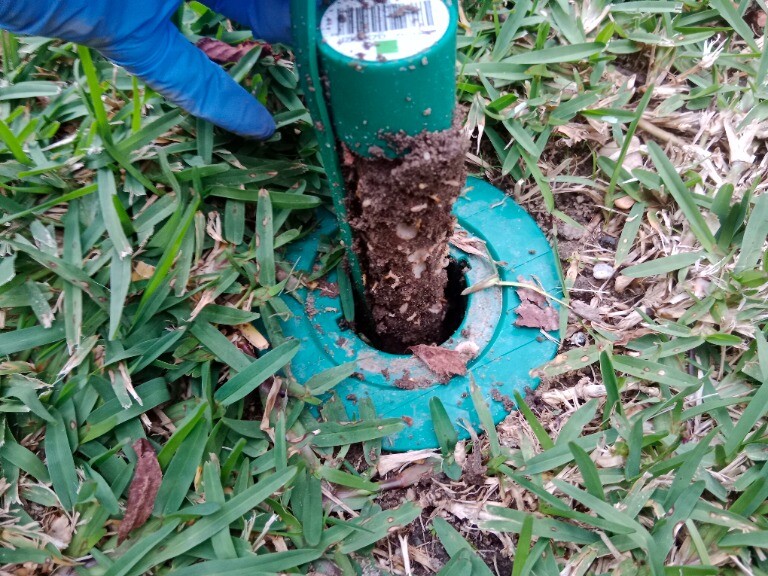
See how stations are placed, checked and baited as part of an ongoing colony management program. This guide explains the practical details Australian homeowners should understand and the next steps worth considering.
Monitoring is essential
Baiting is a managed program rather than a one-off installation. Station placement and follow-up timing depend on the property and recorded activity.A closer look
Stations are positioned where termites are likely to forage, often around the building perimeter. During visits a technician checks for activity and records which stations have been encountered; bait may then be introduced according to the chosen system. No activity in one station does not prove the property is termite-free. Avoid moving lids, gardening over stations or shifting their positions, as this can disrupt monitoring. Ask for a site map and visit notes so you can see what has changed over time and when the next inspection is due.Keep a record of every station and service visit. The provider should explain what activity was observed, how it informs the next visit and when a different approach might be considered. Avoid disturbing the equipment between checks, even when no insects are visible.
What this means for your property
Station placement follows accessible ground and likely foraging areas, not a magical fixed spacing that suits every property. Keep a plan of each station and its service history. Ask what the technician will do if feeding appears in one station but no activity is visible in the house.Baiting and monitoring rely on termites encountering a station and on the provider checking it at agreed intervals. In-ground stations may be used around a perimeter, while an above-ground station can sometimes be fitted near accessible known activity. The site, species, season and level of foraging all influence how quickly there is a result. A station that has no visible feeding on one visit does not prove the entire property is clear of termites.
Ask for the monitoring schedule, what happens when feeding is detected and how the technician records activity over time. Preserve access to station lids when changing paving or landscaping. Bait can be part of an active colony management strategy, but it does not repair timber or remove the need to assess other entry routes. A refillable reticulation system or chemical barrier may be discussed alongside baiting where suitable; each has a different role and maintenance requirement. Ordinary bait used for household ants or rodents is not a substitute for a termite program.
Practical next steps
- Photograph suspicious areas without disturbing them.
- Check nearby moisture sources and accessible timber.
- Arrange a licensed termite inspection for reliable identification.
When to call a professional
If you find suspected activity, unexplained timber damage or conditions that concern you, avoid disturbing the area. A licensed termite professional can identify the evidence, explain the accessible findings and recommend options suited to the property.